Lauren Laverick

I'm a Divorce Solicitor: Here Are My Top 5 Tips for an Amicable Divorce
Photo by Priscilla Du Preez ???????? on Unsplash
/

I’m a Divorce Solicitor: Here Are My Top 5 Tips for an Amicable Divorce

Lauren Laverick
Lauren Laverick
Solicitor
Beecham Peacock Solicitors

The most recent data from the Office for National Statistics (ONS) revealed that England and Wales processed 80,057 divorces in 2022, the lowest amount since 1972. Whilst this is positive for most, there is still a huge proportion of marriages that end in divorce – 34.2% on average, based on the ONS statistics.

For most, going through a divorce is one of the most challenging periods in their lives – “I love you, but I’m not in love with you”, “It’s just not working” and other cliché phrases leave people feeling blindsided, frustrated and angry.

Despite this, it’s in everyone’s best interest if divorce proceedings are resolved amicably, especially if children are involved. Divorces which are taken to court, where one half of the couple is blamed for divorce, are expensive, lengthy and only serve to build resentment.

Remaining amicable in heartbreak is easier said than done, so to help struggling singles move on with their lives, we asked Newcastle family law solicitor Lauren Laverick from Beecham Peacock for expert advice on achieving an amicable divorce.

Leave social media out of it

“It might be tempting to vent relationship frustrations on social media, but airing your dirty laundry online can have serious negative consequences during the divorce procedure,” says Lauren. “Anything you post online can be used as evidence in court, with negative or inflammatory posts about your ex being used as proof of behaviour or character. These are the points of contention which could seriously complicate matters concerning child access and contact, as well as spousal support.

“Speaking from an emotional perspective, negative social media posts, comments or interactions can be perceived as harassment and be incredibly distressing,” they continue. “Negativity online can escalate grievances and make amicable separation harder to achieve, especially if the spectacle is public and can be witnessed by friends, family or your children – involving others in a personal matter.

“Ultimately, it’s best to leave social media out of it, and if communication breaks down, communication instead should only be conducted through a third party – ideally a divorce solicitor.”

Talk to your children

“For children, divorce can become a traumatic experience if dealt with poorly,” Lauren continues. “It’s important that you communicate to your child openly and honestly, reassuring them that their family aren’t going away, but reshaping.

“Children who do not yet understand the delicate and complex nature of relationships may feel as though one half of their parents no longer love them,” they add. “This is also why you should not argue with your ex-partner in front of your child or discuss grievances with them. Your child loves both of you and will likely be mourning the original composition of your family, any attempt to persuade them to ‘pick a side’ is unhelpful and will only cause resentment.

“From a legal perspective, a child who is better informed of the separation will be more receptive to child access times once proceedings are finalised, which is best for both parties.”

File for no-fault divorce

“Introduced on April 6, 2022, no-fault divorces are the ideal option for an amicable separation,” says Lauren. “They reduce potential conflict by removing finger-pointing and absolving either party of any blame for the breakup.

“The removal of blame reduces animosity, instead allowing the couple to focus on more important and practical issues – such as child access, contact and splitting assets,” Lauren continues. “No-fault divorces are also much cheaper as the dispute will not be taken to court, maintaining the privacy of the breakup by keeping grievances out of the public record.

“Not to mention, no-fault divorces are the quicker and simpler option for separation, helping both parties move on with their lives as soon as possible.”

Consider a collaborative law process

“When you start the process of contacting a solicitor about your divorce proceedings, you may want to consider a collaborative law process. This is a newer way of dealing with family disputes, where both parties appoint their own lawyer, but then meet face-to-face to resolve the outstanding issues and proceedings,” Lauren explains.

“This is a very cooperative approach to resolving your divorce, encouraging respectful communication and allowing the couple to have greater control of the outcome. Like no-fault divorces, this process is quick, less expensive and avoids court proceedings.

“Many couples find this a more amicable way of conducting a divorce as it encourages the couple to work together to make decisions on what’s best for everyone involved, including the children. By working together, often couples reach a more understanding solution. However, this method of separation is not ideal if communication has already broken down and working together in this way is likely to cause further tension.”

Contact a professional sooner rather than later

“It’s essential for couples to lean on the expertise of professionals during the divorce proceedings – the earlier this is done, the quicker you’ll get towards reaching an amicable solution,” Lauren says. “Professional divorce solicitors aren’t only knowledgeable, they are non-judgemental and offer an objective viewpoint of this situation. This is helpful in ensuring a calm and rational response to a breakup at a very difficult and emotionally charged time.

“It’s important to investigate the services of a few different solicitors to find one which best aligns with you and your situation. Your solicitor will have your best interests at heart, and should aim to help negotiate a fair and equitable separation which is best for all parties involved – making sure there is no residing resentment after the proceedings are finalised.”

Are you in the process of a divorce and don’t know where to start? If so, we wish you and your partner the best and hope this advice has been helpful in bringing the relationship to an amicable end.

Read more articles by Lauren Laverick.

About Beecham Peacock

Established in 1953, Beecham Peacock is one of the North East’s leading law firms with a wealth of experience in a myriad of different legal fields. Its team of expert solicitors includes specialists in wills, trusts and probate, personal injury, family law and employment law. The firm also offers a wide range of other legal services.

REVEALED: The UK Cities Googling Most About Divorce in 2024
Photo by Firmbee.com on Unsplash

REVEALED: The UK Cities Googling Most About Divorce in 2024

Lauren Laverick
Lauren Laverick
Solicitor
Beecham Peacock Solicitors

In 2022, it was revealed that Birkenhead was the #1 area searching for divorce in the UK from September 2019 to September 2020 – a unique period when marital bonds were challenged throughout the COVID lockdown.

The findings were collated using Google keyword data, finding the area in the UK where the highest number of people are searching for divorce information. Topping the list was the likes of Birkenhead, Birmingham and Bradford.

Fast-forward two years, the UK’s social and political landscape is once again almost unrecognisable: two new Prime Ministers, social tensions over foreign wars, eco-anxiety, recession and a ravaging cost-of-living crisis have all contributed to the national stress.

With one in five of us experiencing stress every single day, we wanted to see how this stress was yet again impacting the UK’s love life – returning to the Newcastle family law specialists at Beecham Peacock Solicitors for their analysis of the latest findings from July 2023 to June 2024.

Key findings:

  • Plymouth is now the UK’s #1 hotspot for divorce.
  • Birkenhead has been demoted, now sitting at the third-highest divorce hotspot.
  • January is the most common month that people search for a divorce.
  • Kingston-Upon-Hull has the highest year-on-year increase for divorce searches.

The heartbreak cities:

Using data from Google’s Keyword Planner tool, Beecham Peacock has identified how many people are searching for divorce in each city, using this data to find the cities with the leading number of searches every month for “divorce” per 100,000 people.

  1. Plymouth – 27.77 monthly searches per 100,000 people.
  2. Portsmouth – 26.89 monthly searches per 100,000 people.
  3. Birkenhead – 22.87 monthly searches per 100,000 people.
  4. Leeds – 22.06 monthly searches per 100,000 people
  5. Bradford – 21.11 monthly searches per 100,000 people.
  6. Bristol – 16.25 monthly searches per 100,000 people.
  7. Leicester – 15.4 monthly searches per 100,000 people
  8. Belfast – 13.11 monthly searches per 100,000 people.
  9. Hull – 13.02 monthly searches per 100,000 people.
  10. Birmingham – 11.53 monthly searches per 100,000 people.
  11. London – 11.16 monthly searches per 100,000 people.
  12. Manchester – 9.84 monthly searches per 100,000 people.
  13. Liverpool – 8.09 monthly searches per 100,000 people.
  14. Glasgow – 7.14 monthly searches per 100,000 people
  15. Edinburgh – 3.26 monthly searches per 100,000 people
UK Hotspots for Divorce
Graphic supplied by Beecham Peacock Solicitors

The findings:

Birkenhead will be happy to hear that it has been dethroned as the #1 UK hotspot for divorce, being succeeded by Plymouth at #1 and Portsmouth at #2 with 27.77 searches per 100k people and 26.89 searches per 100k respectively.

Plymouth saw the largest increase in the top three, with monthly searches for ‘divorce’ increasing by 143% year-on-year since 2023. Searches in Birkenhead saw a notable 75% increase, after recovering slightly in 2023 with 16.33 searches per 100,000 people. Searches in Portsmouth increased slightly since the previous year also, rising by 22%.

Hull, UK
Photo by 43 Clicks North on Unsplash

Shock results: Hull & the New Year

Most shocking of all in the data provided by Beecham Peacock is the year-on-year increase of Kingston-Upon-Hull and the average month in which divorce is searched across all cities.

Hull saw the largest year-on-year increase in monthly searches for ‘divorce’ out of all of the cities analysed. Here, searches rose by 350% since 2023 – that’s over double the increase of Portsmouth, which saw the second-highest year-on-year increase of 143%.

Additionally, Beecham Peacock has found that January is the most common month in which we see an increase in searches for divorce.

The areas which saw the highest search increases in January were more likely to have higher total searches per 100,000 people, suggesting that January is the breaking point for most considering a divorce.

A closer look at the data reveals a pattern of searches rising the most in months outside of spring and summer. Searches peak in months starting from August (the end of summer) through to January (the peak of winter), with the extreme of the peak rising the further into winter we get.

Google Search Volumes for Divorce
Graphic supplied by Beecham Peacock Solicitors

Do more couples separate in winter?

An influential study by Professor Julie Brines in 2016 found that divorce is in fact seasonal, with most breakups happening in winter and official divorce filings happening a couple of months later into the new year.

This is due to numerous factors, including the pressure of the holiday season to be happy and family-oriented, leading couples to a realisation that their relationships have fallen flat.

This theory lines up with Beecham Peacock’s findings, especially in relation to the peak of ‘divorce’ Google searches in January – immediately after the festive holidays. It seems January acts as the investigation stage into filing for divorce, with the official separation taking place in the coming months.

“Divorce can be a daunting and incredibly stressful life change,” says Lauren Laverick, divorce solicitor at Beecham Peacock. “We understand taking that first step takes a lot of courage, and the quicker a divorce can be processed, the sooner couples can begin to heal amicably. A considerate and understanding approach to divorce proceedings is paramount, so we hope the people of Plymouth are confident that they are being represented with their best interests at heart.”

Read more articles by Beecham Peacock Solicitors.

About Beecham Peacock

Established in 1953, Beecham Peacock is one of the North East’s leading law firms with a wealth of experience in a myriad of different legal fields. Its team of expert solicitors includes specialists in wills, trusts and probate, personal injury, family law and employment law. The firm also offers a wide range of other legal services.

Breaking Down Divorce: Answering the UK's Top Google Searches
Image supplied by Beecham Peacock Solicitors
////

Breaking Down Divorce: Answering the UK’s Top Google Searches

Lauren Laverick
Lauren Laverick
Solicitor
Beecham Peacock Solicitors

Divorces are an intimidating legal process to those who aren’t in the know – after all, who entering a marriage considers the possibility that so many dread? This leaves many partners feeling blindsided, overwhelmed and turning to the internet for quick answers.

Compared to July 2023, Google searches for “cheap divorce lawyers near me” have risen by 200%. The problem many find themselves in is that the internet can provide inaccurate information, but many solicitors charge for initial consultation calls, and so the costly divorce process begins before new singles can come to terms with their situation.

We have turned to Newcastle family law specialists Beecham Peacock Solicitors for their answers to the UK’s most-searched divorce questions, using Google search data to collate the queries and trusted solicitors to answer them accurately.

How much does a divorce cost?

“There are several factors that can affect how much a divorce costs, mainly depending on whether the divorce sees the inside of a courtroom or if the couple opts for a no-fault divorce,” Beecham Peacock divorce solicitor, Lauren Laverick, explains. “If couples do agree to a more amicable no-fault divorce, the costs will typically comprise of legal advice, drafting divorce petitions and the handling of necessary paperwork. The standard fee when applying for a no-fault divorce is £593 before additional solicitor charges, which will vary depending on your solicitor and case.”

How to get a divorce.

“To start the legal process of filing for a divorce, you first have to check that your marriage meets the minimum criteria: you must have been married for one year, your marriage must be recognised in the UK and either you or your spouse must be living in England or Wales, as separate rules affect Scotland,” Lauren explains. “Thanks to the no-fault divorce system, neither party has to accept any wrongdoing for the breakdown of the marriage.

“Next, you must apply for a divorce application, which can be done by post or through the UK government’s website. This application will ask for personal details relating to the circumstances of the divorce, including children and financial arrangements,” Lauren continues. “This form can be completed by yourself or a hired solicitor. Once accepted, a copy will be sent to your spouse, who must acknowledge receipt of the letter and confirm that they agree.

“If your spouse agrees, the rest of the process comes down to sorting legal documents which can be arranged by your solicitor. If your spouse disagrees, based on grounds of finances or child custody, then these issues must be resolved,” Lauren says. “This is where you can lean on your solicitor to guide you through an amicable compromise, negotiating with your spouse through mediation, collaborative law processes, or if the disagreement cannot be settled, a more costly court hearing.

“Your solicitor will be crucial during this process if it comes to it – they will have your best interests at heart and protect your rights in the divorce process,” Lauren adds. “Once an agreement is made, you’ll apply for a conditional order, the first of two decrees needed to finalise the process. This informs the court that the divorce can proceed based on the information you’ve given. Then, if the court is satisfied, they will issue a certificate allowing you to apply for the final order.

Around six weeks from the completion of the first order, you can apply for the final order – legally ending the marriage. Once this is accepted, you are officially divorced.”

How long does a divorce take?

“The length of the divorce depends on the complexity of the case, mainly dictated by disagreements between you and your spouse in accepting the initial application,” Lauren says. “The average time to complete a divorce procedure is seven months, but this process will rely heavily on a solicitor processing forms swiftly and finding resolutions between disagreements if they arise, which could extend the time it takes to finalise the divorce.”

How many marriages end in divorce?

“The most recent statistics from the Office of National Statistics showed just over 80,000 divorces in 2022. We can work out from this data that 34.2% of marriages, on average, end in divorce,” Lauren says. “That’s lower than the often-heard claim, ‘half of marriages end in divorce’, but it still leaves many disappointed, stressed and emotionally struggling singles who never imagined they’d be in this position,” Lauren continues.

“It’s the lowest number of divorces there’s been since 1972, however. Hopefully this trend continues and there will be more happy couples as the years go on.”

How much does a divorce cost if both parties agree?

“If both parties agree to the divorce and to the terms, then we can assume this question relates to couples who have filed for a no-fault divorce and agree completely on the nuances of the divorce procedure – including details of finance considerations and child custody arrangements with no amendments,” Lauren continues.

“In this instance, the divorce will be completed as quickly as possible and with no court fees. This means that the average cost of an uncontested divorce will range from £600–£2,000, including the £593 government application form. The range of payment will therefore depend on how much your solicitor charges to process the divorce,” Lauren explains.

“This is why it is important to explore your options when searching for a solicitor, finding a balance between someone who you know will represent your interests well and who is also within your desired budget. As with most things, paying someone who can do the job right the first time may actually save you money compared to someone who can do it cheaply but inefficiently.”

Are you currently at the beginning stages of filing for divorce? If so, we hope your process goes as swiftly and as painlessly as possible.

Read more articles by Beecham Peacock Solicitors.

About Beecham Peacock

Established in 1953, Beecham Peacock is one of the North East’s leading law firms with a wealth of experience in a myriad of different legal fields. Its team of expert solicitors includes specialists in wills, trusts and probate, personal injury, family law and employment law. The firm also offers a wide range of other legal services.

Discover the UK city with the highest number of divorces.
Photo by Seb Doe on Unsplash.

Revealed: The UK City with The Most Divorces

Lauren Laverick
Lauren Laverick
Solicitor
Beecham Peacock

Divorces seem to be all over the news in recent months, thanks to the high-profile splits of Johnny Depp and Amber Heard, Sofia Vergara and Joe Mangiello, and most recently, Ariana Grande and Dalton Gomez.

You’ve probably heard the old adage that 50% of marriages end in divorce – and while the picture isn’t quite as bad as that, divorce rates are still sky-high. In the UK, the divorce rate is estimated at a whopping 42% of all marriages.

But which age groups and which areas are most at risk of their marriage ending in divorce? Is it young couples that have rushed into their union? Or are older partners growing tired of their marriages?

The Census 2021 (released March 2023) breaks down which regions of the country have the highest rates of divorce, as well as the age groups those people belong to.

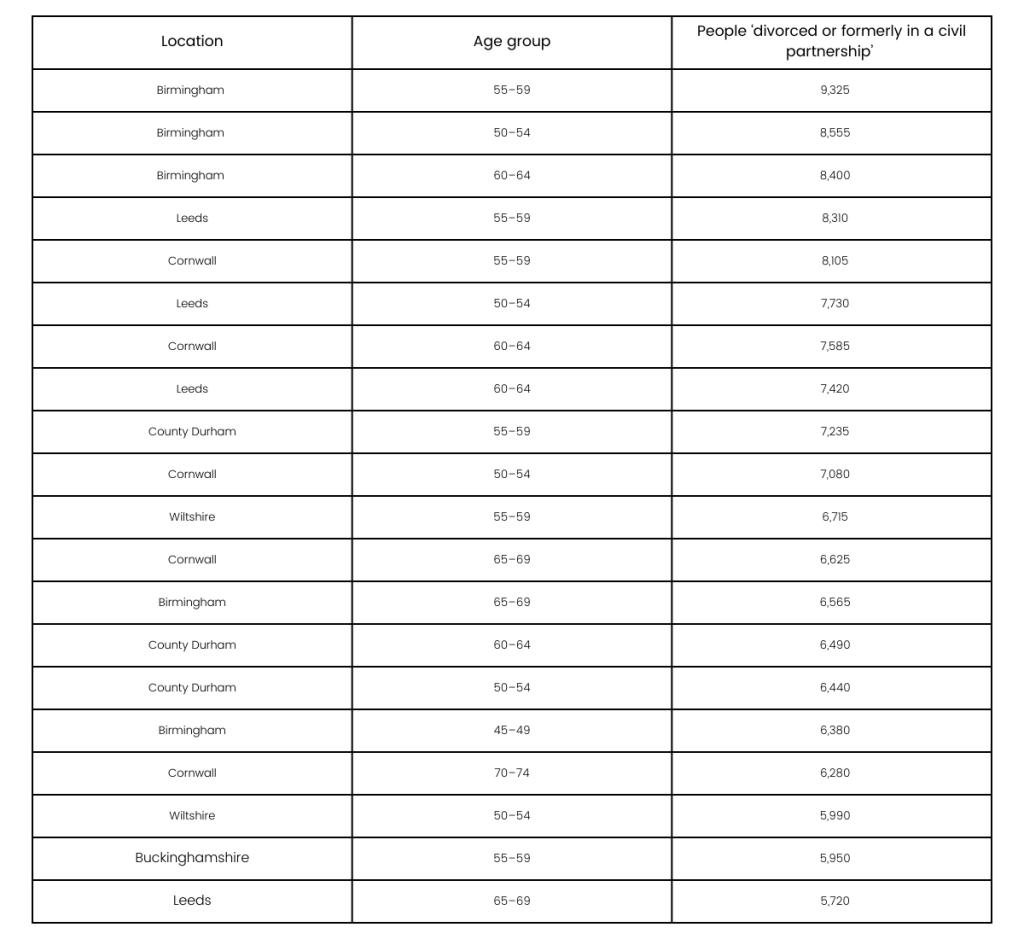
Here, the family law specialists at Beecham Peacock take a look at which age groups in which region are most likely to be listed as ‘divorced or formerly in a civil partnership’ in the 2021 census.

The Census 2021
The Census 2021 (released March 2023).

Registered divorces in Birmingham

Accounting for five of the Census 2021’s top 20 demographics, Birmingham is one of the nation’s leading hotspots for divorce. Birmingham has been one of the UK’s cities with the highest rate of divorce for at least a decade, having also topped Birmingham has been one of the UK’s cities with the highest rate of divorce for at least a decade, having also topped the 2013 list of the most common locations to file for divorce.

Per the Census 2021, there were 9,325 people aged 55–59 living in Birmingham that registered their marital status as ‘divorced or formerly in a civil partnership’ – the largest demographic in the country.

Astonishingly, a similar demographic also in the second city took second place on this list – there were 8,555 people aged 50–54 living in Birmingham also listed under this denomination. The data highlights that people living in Birmingham born between 1962 and 1971 are most likely to be unlucky in love.

It’s not just Gen Xers in Birmingham who are likely to be divorced, however. The population of Brum also accounts for positions three and five in the top 20 most-divorced demographics, with the 45–49, 60–64 and 65–69 age brackets also appearing in the top 20.

Despite these high numbers, the census indicates that, across all age groups, the percentage of registered divorcées in Birmingham is 7.25% – indicating that marriages in Birmingham might be happier than first thought.

Registered divorces in Cornwall

Cornwall was the location that appeared second-most frequently in the top 20 most-divorced demographics. The UK’s most-southerly county, Cornwall featured in five of the top 50 entries for the most-divorced demographics in the Census 2021.

Cornwall had 8,105 people aged 55-59 listed as divorced, the fifth-most in the country. There were also 7,585 people aged 60–64 listed as divorced, as well as 7,080 people aged 50–54.

Older Cornish residents also made up a sizeable chunk of the area’s divorced population. Of the divorced population, those aged 65–69 and 70–74 were registered as divorced 6,625 and 6,280 times respectively.

Across the entire location of Cornwall, there are 53,550 people registered as divorced, out of a total recorded population of 477,420 – indicating 11% of residents are divorced.

Registered divorces in Leeds

Appearing fourth on the list of most-divorced demographics from the Census 2021 is 55–59-year-olds living in Leeds. At the time of the census, Leeds was home to 8,310 people in this age bracket who fell into the ‘divorced or formerly in a civil partnership’ bracket.

Other age groups from Leeds appeared in the Census’ top 20: those aged 50–54, 60–64, and 65–69. Interestingly, across each of the top three cities that appear in the top 20, those aged between 50–70 remain the most likely to be divorced.

53,600 people in Leeds reported that they were divorced, and over 658,000 people are registered as Leeds residents, indicating that 8.13% of the population consider themselves divorced in Leeds.

The highest divorce rates in the UK

Despite having the highest numbers of divorcées, Birmingham, Cornwall and Leeds don’t necessarily have the highest divorce rate when adjusted for their population. Norwich, in fact, has the UK’s highest divorce rate at 12.8%.

Hastings and Blackpool round out the top three places with the highest divorce rates, each with 12.1%. Interestingly, there don’t seem to be any regional trends to the divorce rates – there’s a lot of fluctuation between locations across the North and South.

Divorce is an increasingly common occurrence across the world, thanks in part to the growing prominence of ‘no-fault’ divorce legislation and thanks in part to the growing self-agency of women around the world.

Like marriage, divorce is an event that should be seriously thought out and considered – but if you’ve made your mind up, choosing a reliable divorce solicitor can help guide you through the process and make your life easier.

Read more articles by Beecham Peacock.

About Lauren Laverick

Lauren Laverick, Solicitor at Beecham Peacock, works within the Family Law department. Beecham Peacock has over 60 years knowledge and experience in family law, including domestic violence and child custody concerns.

Recognised as one of the UK’s family law specialists, Beecham Peacock adopt an understanding approach to every case they work on.